

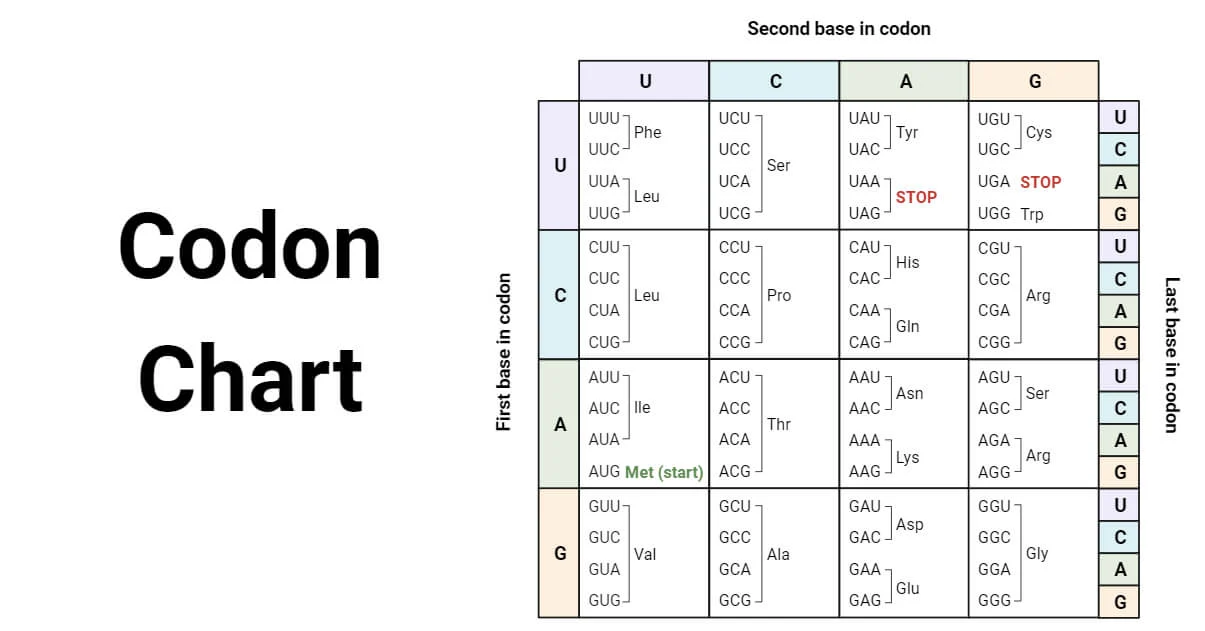
Genetic information, encoded within the DNA, serves as the blueprint for all life forms on our planet. This intricate script is deciphered and translated into functional proteins through an elegant cellular process, and the codon chart plays a pivotal role in this translation. To delve into the specifics of what a codon chart is and its implications in genetics, one needs to begin with the very basics.
The Genetic Code and Codons
DNA is constituted by four nucleotide bases: adenine (A), thymine (T), guanine (G), and cytosine (C). In RNA, thymine is replaced by uracil (U). Sequences of these bases, taken three at a time, form what are known as ‘codons.’ Each codon corresponds to a specific amino acid or a signal (like ‘start’ or ‘stop’). For instance, the codon ‘AUG’ signals the start of protein synthesis and also codes for the amino acid methionine.
The genetic code, defined by these codons, is virtually universal, meaning that the same codons translate into the same amino acids across almost all organisms. This universality underlines the shared evolutionary heritage of all life forms.
The Codon Chart
The codon chart, sometimes referred to as the genetic code table, represents a visual guide to this codon-amino acid relationship. Given the four possible nucleotide bases and the tri-nucleotide nature of codons, there are 64 possible combinations (4 x 4 x 4). Each combination corresponds to an amino acid or a functional signal.
Using a codon chart, scientists, researchers, and students can determine which amino acid corresponds to a particular codon. The chart is organized in a matrix format, taking into account the first, second, and third nucleotide of the codon. One can use this table to predict the sequence of amino acids that will be produced during the translation of a particular mRNA strand.
For an interactive experience and a comprehensive codon table, you can visit GenScript’s codon chart.
Applications and Significance
- Protein Synthesis: The primary utility of the codon chart is in understanding and predicting protein synthesis. By reading the codons on a strand of mRNA, one can anticipate the sequence of amino acids that will form the resulting protein.
- Genetic Engineering: In genetic engineering, scientists often manipulate genes to produce desired proteins. Knowledge of codons and their corresponding amino acids is vital to ensure the synthesized protein is accurate.
- Evolutionary Studies: The near-universal nature of the genetic code is a testament to shared evolutionary lineage. It suggests that all life forms have a common ancestor, reinforcing the theory of evolution.
- Medical Research: Mutations, which are changes in DNA sequences, often result in the alteration of codons. Understanding these changes can help in diagnosing genetic disorders and even in developing therapies.
Conclusion
The codon chart is a crucial tool in the realm of genetics, molecular biology, and bioinformatics. By bridging the gap between the genetic code and protein synthesis, it provides insights into the very mechanisms that drive life. As research progresses and our understanding of genetics deepens, tools like the codon chart, along with digital platforms like GenScript, will continue to play a pivotal role in shaping the future of biological sciences.
